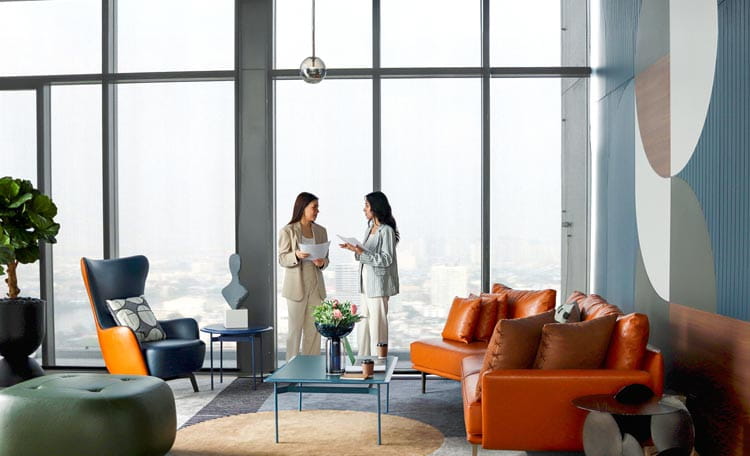
In today’s business environment, agility is a competitive advantage. Selecting the right office solution is no longer just about cost—it is about supporting long-term business growth.
Many organizations are now adopting flexible workspace strategies that allow them to adjust space in line with economic conditions, without being tied to traditional three-year lease commitments. As a result, flexible workspace solutions have become a practical choice for both medium-sized and large companies in Bangkok.
In-Depth Comparison: Two Workspace Formats
Although both fall under the “shared workspace” category, co-working spaces and serviced offices serve different purposes and user groups.
1. Co-Working Space
“Open space, strong community, high flexibility”
Concept: Designed to encourage interaction among users from diverse industries, fostering collaboration and idea exchange.
Format: Typically offers hot desks, dedicated desks, and large shared common areas.
Flexibility: Provides a range of flexible membership terms, with options that can be used as a registered business address.
Key Advantage: A dynamic community ecosystem that supports networking, partnerships, and new ideas.
Best Suited For: Freelancers, startups, and project-based teams seeking flexibility, collaboration, and an active, social working environment.
2. Serviced Office
“Private, fully equipped, professional environment”
Concept: A fully fitted, plug-and-play private office solution with comprehensive support services.
Format: Enclosed private offices that offer a high level of confidentiality and focus.
Flexibility: Can be used as a registered business address, similar to co-working spaces.
Key Advantage: Includes reception services, meeting rooms, and professional workspace management.
Best Suited For: Companies that prioritize a professional image, as well as teams or projects requiring a quiet, structured, and private working environment.
Selecting the Most Suitable Workspace
For a corporate image: A serviced office is ideal for companies that require a formal setting to host meetings and reinforce credibility.
For dynamic workstyles: Co-working spaces are better suited for teams that value flexibility, collaboration, and an engaging work environment.
3 Key Factors Driving the Flexible Workspace Trend
| Factors | Details |
| 1. Workplace Flexibility |
Enables businesses to adjust space requirements based on team size, without being tied to long-term lease agreements. |
| 2. Cost Efficiency | Minimizes capital expenditure, with fit-out and IT infrastructure typically included as part of the service package. |
| 3. Hybrid Work Support | Supports modern work models by providing space solutions that align with flexible, performance-based working styles. |
“The right workspace is more than a location—it is an investment in a platform that drives sustainable business growth.”
Prime Locations and Leading Providers in Bangkok’s CBD
Flexible workspace options are primarily concentrated in key CBD areas such as Sathorn, Silom, Asoke, and Sukhumvit. These locations offer excellent connectivity via the BTS and MRT networks and are typically situated within Grade A office buildings.
| Workspace Providers | Key Strengths & Style |
| WeWork & JustCo |
Contemporary design with spacious common areas, focused on fostering business networking and collaboration. WeWork JustCo The Collective
|
| IWG (Regus, Spaces, HQ) |
The most extensive global network, offering a range of options from formal corporate setups to more creative workspace environments. Spaces Regus |
| Common Ground & CSO |
Premium work environments designed to enhance productivity, with a strong emphasis on team collaboration. Common Ground CSO |
In conclusion, choosing a workspace is no longer just about budget or location—it is about selecting a strategic tool that aligns with your organization’s pace of growth. Whether your business prioritizes speed, flexibility, or a professional global image, flexible workspace solutions offer the adaptability to support your needs in today’s evolving business environment.