

India’s IT industry has been pushing boundaries and achieving remarkable feats. According to NASSCOM, the technology services sector in India is estimated at nearly USD 245 billion and is forecasted to reach close to USD 500 billion by the end of this decade.
The recently announced Maharashtra IT-ITES policy 2023, which was passed by the cabinet and for which the gazette is expected soon, is intended on an ambitious mission of making the state “the tech capital of India”. At present, it’s capital district of Mumbai already dons multiple hats, being the “financial capital”, the “data centers capital” and the “entertainment capital” of India. The state is clearly wanting to embark on consolidation of its position as an industrial powerhouse, and it aims at capturing a higher share of the fast-growing technology segments – IT-ITES, the IR 4.0 sectors and the AVGC industry – Animation, Visual Effects, Gaming and Comics. The state government has been consistently updating its IT-ITES policy ever since the first version it released in 1998, followed by updates released in 2003, 2009 and 2015.
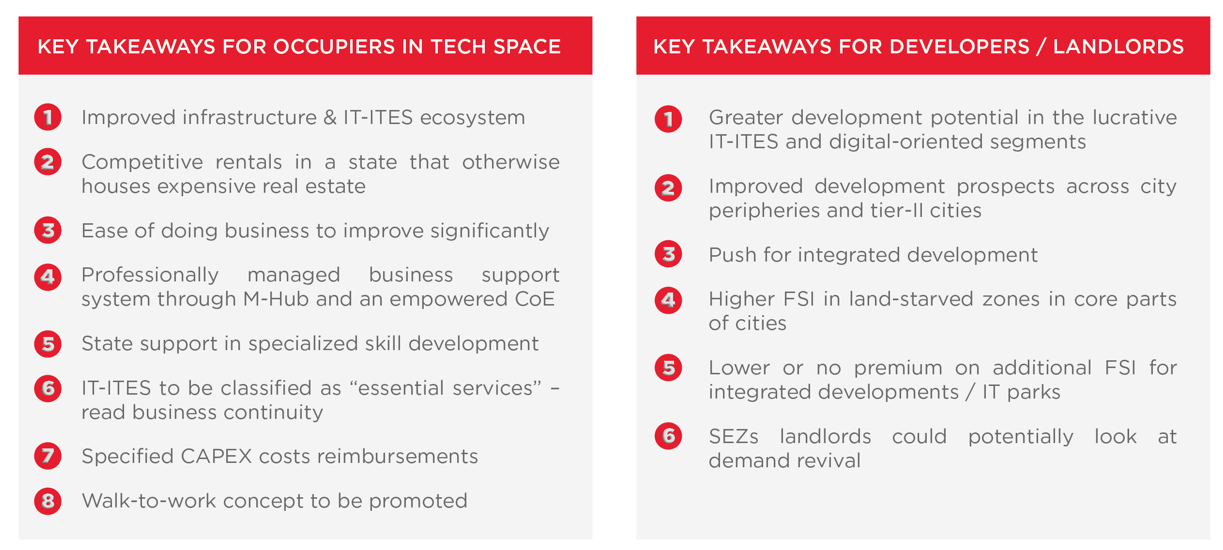
Through the new IT policy, the state aims to attract investments of INR 95,000 crores in the IT-ITES and IR 4.0 sectors, and also achieve export target of INR 10 lakh crores. Together, the policy envisages to create technology-centric jobs for 3.5 million people. To achieve these targets, the state is empowering newly created agency – the M-Hub – with clear mandate to uplift the IT-ITES ecosystem in the state. Interestingly, resources from existing reputed national and state level agencies such as the MIDC, NASSCOM and ITPO will be utilized to serve specific needs of the IT industry. Incentives for occupiers on stamp duty reduction, power tariffs, property tax, etc. have been announced, besides reimbursement of certain capex costs. To fulfill the demand-supply gap in the tech-centric manpower, leading institutes and industry bodies have been roped-in to partake in the skill development exercise. Probably, it is for the first time a skill development progress monitoring target has been announced by any state – 15% p.a. increase in human resource availability.
Gautam Saraf - Maharashtra’s IT-ITES policy sets an example for government’s approach towards promoting industry more holistically rather than looking at it in isolation. The incentives are well-wounded and will create significant value for technology sector occupiers in the West India markets. A professional approach to hand-holding emerging sectors such as AVGC and IR 4.0 by supporting them through the initial CAPEX cycle and skill development is rather commendable. Commercial development could widen to newer geographies within existing tier-I cities as well as in prominent tier-II cities.
