• Since 2024, nearly 200 defence manufacturing projects have been announced or opened in Europe.
• The largest share of defence manufacturing investment is going to the UK, Germany and France, with Poland leading in Central and Eastern Europe.
• From 2024 to mid-2026, Chinese companies leased more than 2.5 million sq m of industrial and logistics space in the European countries tracked.
• In Czechia, these new sources of demand have not yet had a significant impact; traditional manufacturers and logistics operators remain the main drivers of demand.
Europe’s industrial and logistics real estate market is gradually diversifying. Alongside traditional sectors such as manufacturing and logistics, new sources of demand are emerging, linked to the expansion of European defence manufacturing and to Chinese companies shifting part of their activities directly to Europe. This is according to a new analysis by the advisory firm Cushman & Wakefield, Future Flows: Global Dynamics & European Industrial Real Estate. The Czech market is not yet seeing a fundamental change in the structure of demand, but developments in Europe suggest that the range of potential tenants may gradually widen in Central Europe as well.
According to Cushman & Wakefield’s analysis, rising defence spending by European countries is increasing manufacturers’ order books and driving the expansion of production capacity, which in turn is creating new demand for industrial property. Demand is also being supported by European countries’ push for greater self-sufficiency and more resilient supply chains, which is moving production and the sourcing of materials closer to European markets. From the beginning of 2024 to August 2026, nearly 200 investments and openings of manufacturing facilities linked to the defence industry were announced across Europe. The highest concentration of these investments is in the UK, Germany and France, followed by other markets including Spain, Italy, Sweden, Turkey, Belgium and the Netherlands. Central and Eastern Europe is also positioning itself actively, led by Poland, where demand is growing in particular around the production of ammunition and other defence capabilities.
Sally Bruer, Head of EMEA Logistics & Industrial Research at Cushman & Wakefield: “What is particularly notable is how quickly defence manufacturers’ investment is translating into real estate requirements. More than half of the facility commitments we tracked involve new sites, reflecting manufacturers' need to increase capacity and secure long-term production capability. As large procurement programmes move through the supply chain, we expect this to drive increasing demand for smaller and mid-sized industrial facilities across the broader supplier ecosystem as businesses expand production capacity to support the next phase of defence growth.”
Chart 1: Newly opened and announced defence manufacturing facilities by country and category (2024 – August 2026)
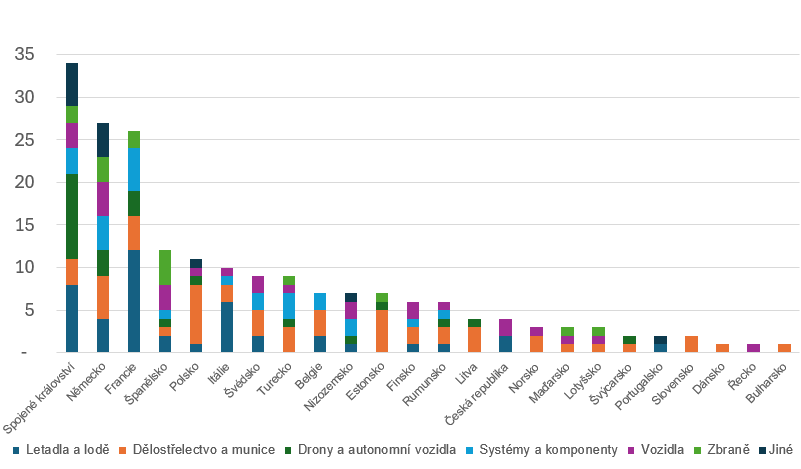
Source: Cushman & Wakefield
According to the analysis, more than half of the projects tracked, 54%, involved creating new production facilities outside existing sites. New construction accounted for 36% of all projects, and a further 18% were acquisitions, leases or conversions of existing buildings. The remaining 46% were expansions of existing production capacity. For newly created facilities, projects of 10,000 to 25,000 sq m are the most common, with the average size of a new facility at approximately 20,000 sq m.
An important point for the real estate market is that the defence industry does not always require highly specialised buildings. Part of the demand can be accommodated in standard industrial units, while some operations call for higher security standards or specific building modifications. This creates opportunities for both new construction and for the refurbishment and repurposing of existing properties. As a broader range of suppliers becomes involved, growing interest in smaller and more flexible industrial space can also be expected.
Chinese companies are moving their activities closer to European customers
The second trend that, according to the analysis, is reshaping the European industrial market is a gradual change in the behaviour of Chinese companies. They no longer rely solely on exports from Asia; increasingly, they are also building their own manufacturing, distribution and logistics capacity directly in Europe. According to the Future Flows report, Chinese companies leased more than 2.5 million sq m of industrial and logistics space from the beginning of 2024 to mid-2026. The analysis covers transactions of 5,000 sq m and above in selected European countries, including the Czech Republic.
This is not limited to manufacturers. Active groups also include logistics companies and e-commerce players, which are setting up distribution and order fulfilment centres closer to European customers.
In Czechia, the new European trends are not yet clearly visible
Cushman & Wakefield has not yet seen a fundamental change in the structure of demand on the Czech market. It continues to be made up mainly of manufacturing companies, including firms linked to the automotive industry, and logistics operators. However, developments in Europe suggest that demand is gradually coming from other sectors as well. Investment in defence manufacturing and the shift of Chinese companies’ activities may in time bring new opportunities to Central Europe too.
“The Czech market usually reacts to European trends with a certain delay, so we can expect growing demand from the defence industry and from Chinese companies to gradually show up here as well. What will matter most is the availability of suitable sites and buildings, the speed of permitting processes, and the ability to offer space that meets specific operational and security requirements. Alongside new construction, we therefore also see significant potential in the modernisation and repurposing of existing industrial sites,” says Jiří Kristek, Head of Occupier Services at Cushman & Wakefield.
The long-term rise in European defence spending, from €419 billion in 2025 to a planned €547 billion in 2029, together with continued investment by Chinese companies, suggests that this is a structural rather than a short-term trend. For the Czech market, neither trend is yet a dominant source of demand, but in the long term both may widen the range of companies looking for manufacturing and logistics space in Central Europe.