• New York's Upper Fifth Avenue returns to first place in the global ranking of the world's most expensive shopping streets after three years, with rents up 35% year on year
• Global rents on shopping streets rose by an average of 3.0%, with almost half of the tracked streets (49%) recording growth
• Pařížská Street defended its 19th place, with rent stable at €2,820 per square meter per year
• Prague ranks among Europe's most attractive markets with growth potential, serving as a gateway to the Central European market and a bridge between West and East
• Brands' interest in Prague is confirmed by, among other things, the opening of one of the largest Oysho stores in the world on Na Příkopě, the new Massimo Dutti on Pařížská Street, and the planned opening of one of the largest Zara stores in the world
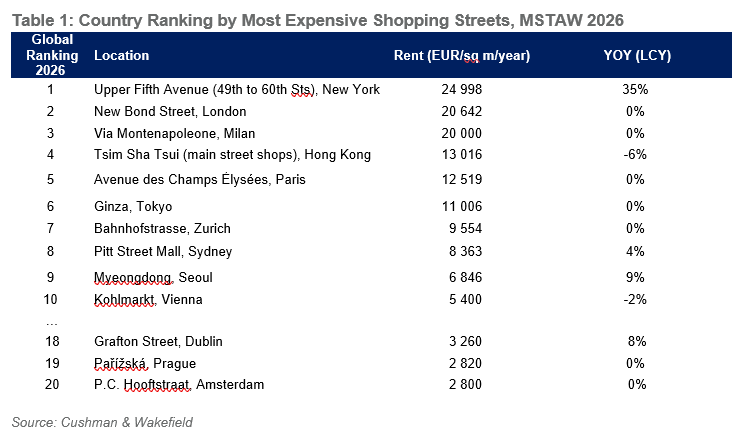
Prague continues to be home to the most expensive shopping street by rent1 in Central and Eastern Europe, according to the 36th edition of the prestigious Main Streets Across the World ranking by real estate advisory firm Cushman & Wakefield. Pařížská Street ranked 19th in the global ranking with annual rent of €2,820 per square meter, unchanged from last year. In a year marked by significant swings in the global market and New York's return to first place, Pařížská Street confirms that predictability and stability can be at least as attractive to brands planning long-term expansion as record growth.
The world's most expensive shopping street is once again New York's Upper Fifth Avenue. Rent there rose by 35% year on year to €24,998 per square meter. The street thus overtook last year's leader, London's New Bond Street, which dropped to second place with annual rent of €20,642 per square meter and zero growth. Third place went to Milan's Via Montenapoleone with annual rent of €20,000 per square meter, also unchanged. Upper Fifth Avenue last led in 2023, fell to third place last year and this year saw a sharp rise in rent, which shows how cyclically the world's most prestigious shopping streets develop.
Rents worldwide grew this year as well, by 3.0% year on year. Of the 147 tracked streets, rent increased on 72 (49%), fell on 28 (19%) and remained unchanged on 47 (32%). The gap between the world's most expensive and cheapest street by rent widened further this year: the most expensive street is 106 times more expensive than the cheapest, compared with 98 times last year. Such a gap has not been recorded since the end of the pandemic.
While there were significant shifts at the top of the ranking, Pařížská Street held its rent at last year's level. Na Příkopě Street, which is only a few euros per year cheaper than Pařížská Street, is at almost the same level. This makes them among the most stable locations for international brands looking to establish themselves in the Central and Eastern Europe region.
Jan Kotrbáček, International Partner and Head of Retail Leasing for CEE at Cushman & Wakefield, adds: “Pařížská Street has long held an exceptional position not only within the Czech Republic but across Central and Eastern Europe. This year's stable rent confirms its resilience and strong market position, combined with 100% occupancy of retail space. Interest from premium global brands shows no sign of weakening, as this year's new openings and expansions of existing stores demonstrate. Prague still has plenty to offer, and in our view its importance on the map of European luxury retail will continue to grow.”
The importance of Pařížská Street is also reflected in its dynamics. While in past years the major changes took place mainly in other parts of Prague's main shopping streets, the most significant ones of the last few years have belonged to Pařížská. The biggest change in recent years is the opening of the renovated Fairmont Golden Prague hotel. Alongside gastronomy concepts, flagship stores of Max Mara, Ermanno Scervino, Grenardi, Pasquale Bruni and Damiani have opened here, as well as the La Table boutique. The street has also become home to the contemporary art gallery KodlContemporary and the art store KC Editions. The hotel renovation will be followed by the second part of the project, the revitalization of Miloš Forman Square led by the Danish studio ADEPT. It will bring not only a modernized public space but also new premises for luxury brands. This year, Massimo Dutti, Patek Philippe and Longines also opened flagship stores on Pařížská Street. Brunello Cucinelli and Cartier, meanwhile, expanded their stores.
Even with stable rent, Pařížská remains by a wide margin the most expensive shopping street in the entire Central and Eastern Europe region and has held a place in the world's top 20 for several years in a row. The Czech capital thus ranks among Europe's leading destinations for retail brands from around the world.
The most attractive shopping zone in Prague's city center, the compact axis between Pařížská Street, Na Příkopě and Wenceslas Square, remains limited in retail space supply, and demand for premium space continues to exceed supply. Its momentum has recently been boosted, in addition to the aforementioned Fairmont Golden Prague hotel, by the 100 Yards and Trinity Palác projects and the renovated lower part of Wenceslas Square. The most important upcoming projects include the redevelopment of the Kotva department store, the Savarin project and the revitalization of the upper part of Wenceslas Square.
Prague in the European Context
In this year's edition, Cushman & Wakefield also included Prague among the markets with the greatest growth potential worth watching, along with Austin, Singapore, Bangkok, Ho Chi Minh City, Mumbai, Madrid and Barcelona. The reasons are a combination of growing local purchasing power, high tourist visitation in Prague, the city's unique architecture, properties and landmarks, an improving environment and a growing offer of quality accommodation and experiences. Prague is also perceived as a very safe and promising city in today's world. For many retailers it is a gateway to Central and Eastern Europe as well as a bridge between West and East. Many brands have their flagship store for the CEE region in Prague. Thanks to a very good tenant mix and the city's potential, leading global retail brands have long been heading to Prague.
These markets are also linked by the sectors that attract the greatest interest among tenants.
Food and beverage (F&B), beauty, wellness and everyday athleisure are common growth drivers everywhere. In global markets, some brands compete for market share, for example Oysho, Lululemon, Alo or ON, which fight for the same customer and are expanding significantly. The next wave of new tenants in Prague is expected to come from beauty and F&B operators.
Jan Kotrbáček adds: “Prague's attractiveness is clearly confirmed by the newly opened major stores on Na Příkopě, for example Oysho, covering almost 1,200 square meters, or the Lego flagship store. The Stradivarius concept and the Peek & Cloppenburg department store are planned to open later this year. Wenceslas Square will also change significantly following the highly successful renovation of its lower part. A new Zara store, which at 10,000 square meters ranks among the largest in Europe, should open there by the end of the year. Much more awaits Prague's city center next year as well. It is clear that Prague will continue to grow and, as a gateway between West and East, will attract further new brands and concepts.”
Europe and Outlook
Average rent growth in Europe reached 2.9% in 2026. Of the 57 tracked European shopping streets, only two recorded a decline, Vienna's Kohlmarkt and Berlin's Tauentzienstraße, both by approximately 2%. The strongest rent growth, on the other hand, was recorded on Bucharest's Calea Victoriei, at 29%. Tenant interest there was boosted by both improvements to the public space and a significant increase in tourism, which strengthened the street's position in the region.
2026 began with cautious optimism, but the conflict in the Middle East since the end of February has once again increased inflationary pressures, and central banks have backed away from easing rates. Consumers are cautious, but businesses remain optimistic and the economy is proving more resilient than expected. With demand continuing to prevail, Prague, with Pařížská Street, Na Příkopě, Wenceslas Square and other adjacent locations in the center, is well positioned to remain the dominant retail destination in Central and Eastern Europe in 2027 as well.
Full report and global ranking available here: Main Streets Across the World
1 The comparison covers the world's prime shopping streets. The ranking includes 50 countries, each represented by the one street with the highest achieved rent. More on the methodology can be found at the end of this release.