
-
Cushman & Wakefield’s latest analysis finds that the fastest-growing data centre markets are not always the lowest-risk markets
-
Resilience is emerging as a critical factor in supporting uptime, expansion potential and long-term asset performance
The next phase of data centre growth in Asia Pacific (APAC) will be shaped not only by where demand exists, but by where that demand can be supported reliably over time. According to Cushman & Wakefield's Asia Pacific Data Centres & Climate Resilience report, 67% of assessed data centre sites across APAC are exposed to moderate to high levels of climate risk today, highlighting that climate risk is no longer a future consideration, but an operational reality for many of the region's most important data centre markets.
As digital infrastructure continues to expand across the region, climate-related hazards such as flooding, extreme heat and drought are becoming a more significant consideration in data centre planning and operations. These risks can influence everything from cooling requirements and water availability, to power reliability and business continuity, making climate resilience an increasingly important consideration for investors, developers and operators.
Climate Risk is Becoming a Strategic Location Decision
Climate risk profiles vary considerably between markets, cities and submarkets. As a result, location strategy is becoming more nuanced, requiring operators to assess how climate exposure, infrastructure resilience, and growth capacity intersect rather than evaluating these factors independently.
While traditional drivers such as demand, connectivity and access to power remain critical, operators are placing greater emphasis on understanding how climate exposure may affect long-term performance, operational reliability and expansion potential across different locations.
Andrew Green, Head of Data Centre Group, Asia Pacific at Cushman & Wakefield, said: “Rather than slowing development, climate risk is reshaping how operators evaluate sites, plan infrastructure and prioritise investment across APAC. Operators are incorporating climate intelligence into site selection, engineering design and operational planning, recognising that resilience is critical to sustaining performance over the long term. As digital infrastructure requirements continue to grow, resilience will play a larger role in determining where and how capacity can be delivered.”
Resilience Emerges as a Critical Enabler of Growth
While climate-related risks are becoming more pronounced across the region, climate risk and growth increasingly coexist across APAC's data centre markets. The report notes that the fastest-growing data centre markets are not always the lowest-risk markets, yet many continue to attract substantial investment and development activity.
This highlights a shift in approach, with operators focusing more on identifying, managing and adapting to climate risks, and future-proofing facilities in these markets.
As the operating landscape evolves, resilience is also moving beyond a risk mitigation exercise and emerging as a critical enabler of investment, expansion and long-term asset performance. Organisations that can successfully embed resilience throughout the data centre lifecycle are likely to be better positioned to support uptime, accommodate future growth and respond to changing operating conditions.
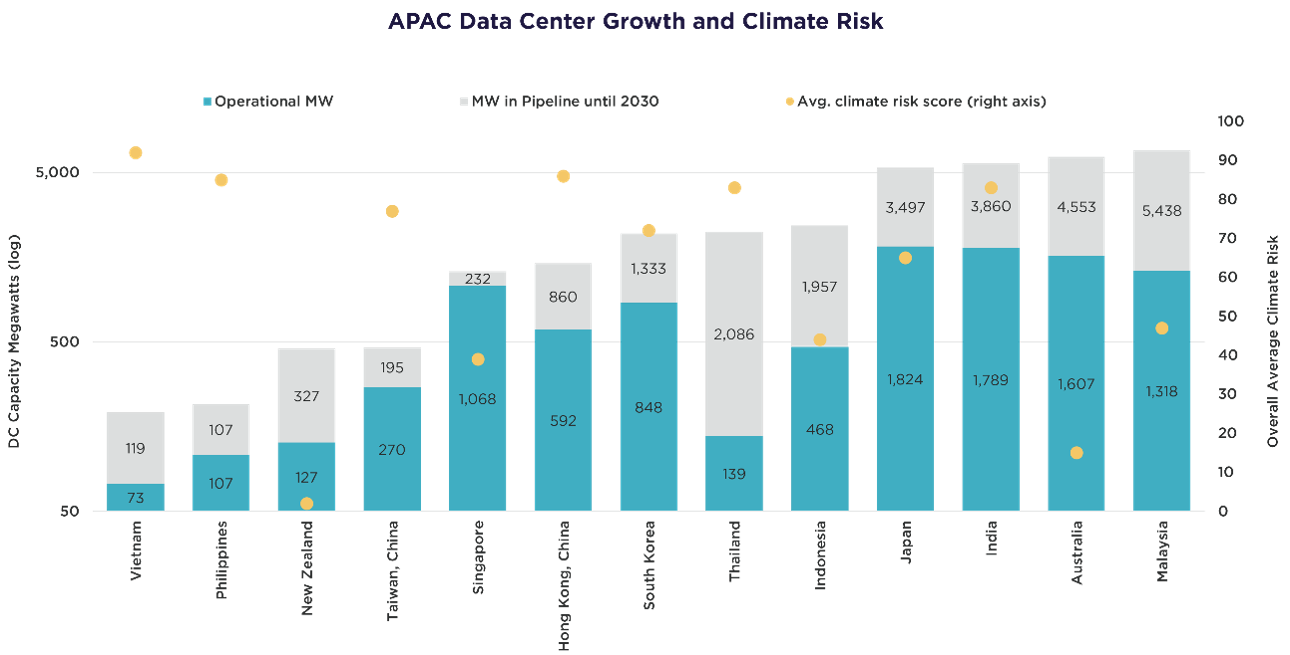
Figure 1: APAC Data Centre Growth Forecast and Climate Risk Score | Source: Cushman & Wakefield
Beyond Facility Resilience
As resilience becomes increasingly critical to supporting investment, expansion and long-term asset performance, attention is shifting beyond the data centre facility itself. Reliable power networks, transmission infrastructure and utility systems are playing a growing role in sustaining data centre operations and future growth.
Climate-related disruptions are placing growing pressure on these systems, elevating the importance of power reliability, infrastructure readiness and utility resilience across APAC's data centre markets. In turn, these factors are becoming key differentiators for markets competing to attract future data centre investment and development.
As AI adoption and higher-density workloads require more advanced power and cooling infrastructure, the resilience requirements needed to support future capacity growth will continue to rise.
Matt Clifford, Head of Sustainability & ESG, Asia Pacific at Cushman & Wakefield, said: “Historical climate conditions are no longer sufficient inputs for long-term infrastructure planning. Climate intelligence should be integrated much earlier into investment, development and operational decisions to help organisations better understand future risks and improve resilience outcomes. Future-ready data centres will require planning assumptions that reflect tomorrow's climate realities, not yesterday's conditions.”
Four Pathways to Resilient Growth
There is no single blueprint for resilient growth across APAC's data centre markets. Different markets face distinct combinations of climate, infrastructure and development challenges, requiring tailored approaches that reflect local operating conditions and growth priorities.
Johor demonstrates both the opportunities and infrastructure considerations associated with rapid expansion. Tokyo shows how mature markets can continue to grow despite elevated climate exposures. Mumbai highlights how strong demand fundamentals can sustain investment activity in higher-risk environments, while Sydney underscores the value of long-term planning and future-proofing infrastructure assets. Together, these examples demonstrate that resilience strategies must be tailored to local market conditions, infrastructure ecosystems and growth ambitions.
Pritesh Swamy, Head of Research & Consulting, Data Centre Group, Asia Pacific at Cushman & Wakefield, said: “Climate risk does not automatically determine investment outcomes. Many of APAC's fastest-growing data centre markets continue to attract investment despite differing risk profiles. Some markets benefit from lower climate risk, while others continue to thrive despite greater exposure because operators have invested in the infrastructure, planning and operational capabilities needed to manage those risks. The key for operators is to understand each market's unique risk profile and embed resilience into every stage of the data centre lifecycle.”
Looking Ahead: Building for Long-Term Resilience
Demand for digital infrastructure across APAC is expected to remain strong as digitalisation, cloud adoption and artificial intelligence continue to drive capacity requirements. However, future competitiveness will depend on more than demand alone. It will also be shaped by how effectively operators balance climate considerations with other critical market fundamentals like connectivity and power availability.
As APAC's data centre markets continue to evolve, local market conditions will also play a greater role in shaping development strategies. Different markets will require different approaches to managing risk, scaling infrastructure and supporting long-term growth.
Ultimately, the markets best positioned for long-term success will be those that can align strong demand fundamentals with the planning, infrastructure and operational capabilities needed to adapt to a changing climate risk profile.
Andrew Green, Head of Data Centre Group, Asia Pacific at Cushman & Wakefield said: “While Sydney remains a key market for data centre investment and development, the next phase of growth will increasingly be determined by the ability to deliver infrastructure that is resilient, reliable and capable of supporting long-term demand. With artificial intelligence, cloud computing and digitalisation driving greater capacity requirements, investors and operators are looking beyond traditional location fundamentals to consider climate exposure, power availability and the long-term resilience of supporting infrastructure. Sydney's competitive advantage will depend not simply on how much new capacity it can deliver, but how sustainably and reliably that capacity can operate over the coming decades.”
“Australia's data centre sector is entering a period where climate resilience is becoming just as important as connectivity, power and access to land in determining investment decisions. Extreme heat, flooding and pressure on energy infrastructure can have significant implications for operating costs, cooling requirements and business continuity. For developers and investors, these risks need to be considered at the earliest stages of site selection and development planning. The ability to anticipate and manage climate exposure will increasingly differentiate the assets that attract long-term investment from those that face greater operational challenges.”
“Sydney provides a strong example of why long-term infrastructure planning is critical to the future of the data centre sector. As demand for AI-enabled infrastructure accelerates and facilities become more power-intensive, the resilience of the surrounding electricity network and utility infrastructure is becoming as important as the performance of the data centre itself. Operators need to understand not only the climate risks facing an individual site, but also the vulnerability of the infrastructure supporting it. Those that integrate climate intelligence into site selection, engineering and operational planning will be better positioned to accommodate future growth and protect asset performance.”
About the Report
The Asia Pacific Data Centres & Climate Resilience report was developed by Cushman & Wakefield in collaboration with Jupiter Intelligence, combining climate risk analytics with Cushman & Wakefield's data centre market expertise. The analysis covers more than 300 data centre locations across 30 cities in 13 markets, evaluating exposure to eight climate hazards, including flood, heat, wind, drought, fire, precipitation, hail and cold. It examines how climate risk may influence the future deployment, development and investment of data centre infrastructure across APAC.
About Cushman & Wakefield
Cushman & Wakefield (NYSE: CWK) is a leading global commercial real estate services firm for occupiers and investors with approximately 53,000 employees in over 350 offices and nearly 60 countries. In 2025, the firm reported revenue of $10.3 billion across its core service lines of Services, Leasing, Capital markets, and Valuation and other. Built around the belief that Better never settles, the firm receives numerous industry and business accolades for its award-winning culture. For additional information, visit www.cushmanwakefield.com
