
• The number of university students in the Czech Republic is growing faster than student accommodation capacity, with just 21 beds available per 100 students
• A comparison of demand and available capacity indicates a nationwide shortfall of approximately 124,300 beds, with the greatest pressure in Prague and Brno
• Private student accommodation accounts for only 11% of total capacity, while rents continue to rise across all segments
The number of university students in the Czech Republic rose by 5% year on year to 330,500 in the 2025/2026 academic year, the fastest rate of growth in several years. Over the same period, student accommodation1 capacity increased by just 0.3% to 68,100 beds. This means that only 21 beds are currently available for every 100 students. The findings come from the new Student Accommodation 2026 study prepared by real estate consultancy Cushman & Wakefield.
After declining between 2013 and 2019, the number of university students in the Czech Republic has begun to rise again. Since reaching a low in 2019, the student population has grown by 14.5%. International students are also contributing to this increase, with approximately 59,000 studying in the Czech Republic this year, 5.5% more than last year. They now account for almost 18% of all university students, with the largest groups coming from Slovakia and Ukraine.
Demand for student accommodation is concentrated in a small number of university cities. Prague, with 137,700 students, accounts for 42% of the country’s total student population, followed by Brno with 65,500 university students. However, Olomouc has the highest proportion of students relative to its population, with students making up as much as 23% of the city’s residents.
The growing student population is placing pressure on the limited supply of accommodation, particularly in the largest university cities. Cushman & Wakefield’s analysis compared the number of students studying outside their home region with the available student accommodation capacity. In Prague, only 27,900 student beds are available for 77,200 students arriving from other regions, while Brno has just 14,300 beds for 44,100 such students. Nationwide, almost 192,400 students study outside their home region, while student accommodation capacity totals only 68,100 beds. The indicative gap between demand and supply is therefore approximately 124,300 beds, confirming the persistent shortage of student accommodation in the Czech Republic.
In terms of the ratio between demand and capacity, the situation is most acute in Olomouc, where there are 3.6 students from outside the region for every available bed, compared with the national average of 2.8. Ostrava has the lowest ratio, at 2.1 students per bed.
“The indicative gap between potential demand and dedicated supply, together with the limited scale of private provision, points to scope for further institutional investment and professionalisation. However, development viability remains highly location-specific and depends on achievable rents, construction costs and the depth of local demand,“ says Alina Cazachevici, Head of Valuation & Advisory, Hospitality & Alternatives, CEE & SEE at Cushman & Wakefield.
Private sector remains small as rents continue to rise
Public student accommodation continues to account for the vast majority of supply, representing 89% of the total capacity of 68,100 beds. Private student accommodation accounts for only 11%, despite its capacity increasing by 0.7% year on year. The supply of student accommodation could expand further in the coming years. Approximately 1,300 beds are currently under construction, with a further 3,050 planned. Even if all projects in the pipeline are delivered, however, total capacity would increase by only 6.4%, which would not eliminate the current shortage of student accommodation.
Rents increased across all segments. Private student accommodation in Prague remains the most expensive, with an average monthly rent of CZK 13,800 per bed. In regional cities, the average is CZK 8,600, approximately 60% lower. Public student accommodation remains considerably more affordable, averaging CZK 6,000 per month in Prague and CZK 4,700 in the regions. The fastest growth was recorded in public halls in regional cities, where rents rose by 5.9% year on year.
“The number of students per bed confirms that university halls and purpose-built student residences cannot meet the needs of everyone moving from another region to study. A significant proportion of students therefore live in shared flats, stay with relatives or choose other forms of housing. Student accommodation capacity is important, but it represents only one part of the overall housing supply available to students,” says Kamila Breen, Head of Research & Insights at Cushman & Wakefield.
Chart 1: Average monthly rent per bed
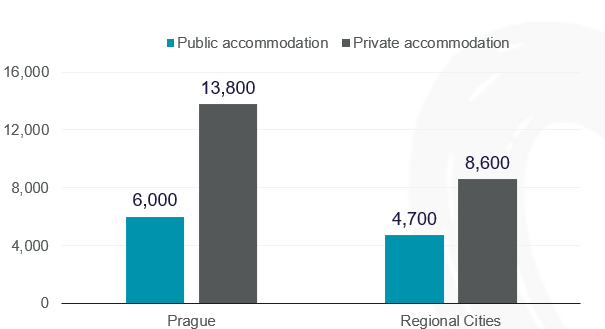
Source: Cushman & Wakefield
The current supply of student accommodation is still failing to keep pace with growing demand. Although the private segment is gradually expanding, its share of total capacity remains low. Given limited new development, rising costs and differences between individual cities, further growth in student accommodation will depend primarily on location, the availability of suitable sites, project economics and cooperation between the public and private sectors.
Download the full report from our Insights section.
1/ The analysis includes only accommodation projects specifically designed and operated for students, comprising university-owned dormitories and purpose-built student accommodation (PBSA). Projects targeting a broader group of young residents, such as micro-apartments, co-living schemes, build-to-rent developments or other forms of rental housing for young professionals, are excluded, even where students may represent a significant share of occupants.

