• Poland increased its share of CEE investment volume from roughly one-third to 56.7% in a year, recording its strongest first half since 2018
• Western European capital, led primarily by Germany, nearly doubled its regional share from 12.8% to 22.7%, while the share of CEE-origin capital fell from 64.8% to 55.0%
• Residential investment rose by 256% year on year, mainly due to significant portfolio transactions in Poland and the Czech Republic, making it the region’s fastest-growing sector
Cushman & Wakefield has released its CEE Investment Market Update for H1 2026. According to the report, total investment volume across the CEE-7 region (Bulgaria, the Czech Republic, Hungary, Poland, Romania, Slovakia and Serbia) reached approximately EUR 5.4 billion. This was broadly unchanged year on year (down 0.3%) and 16.1% lower than in the second half of 2025, in line with the region’s usual seasonal pattern. Beneath the stable headline figure, however, activity shifted markedly towards Poland, which alone accounted for 56.7% of regional volume and recorded its strongest first half since 2018.
Three structural shifts defined the first half of the year. First, regional liquidity became significantly more concentrated in Poland. Its share of total CEE investment volume rose from roughly one-third to 56.7% in a year, while the Czech Republic, the region’s leading market for the whole of 2025, fell to second place. Second, there is a limited supply of product. In several markets, most notably the Czech Republic, the main constraint is no longer a shortage of capital but a lack of high-quality, institutional-grade investment assets available for sale. Third, the sources of capital are shifting. Domestic capital remains dominant within individual markets, while cross-border investment within CEE is weakening. This is creating opportunities for Western European capital, particularly from Germany. The share of CEE-origin capital fell from 64.8% to 55.0%, while Western European capital nearly doubled its share from 12.8% to 22.7%.
Jeff Alson, Head of EMEA L&I Capital Markets, Cushman & Wakefield: “Czechia's restricted investment supply is evident when compared with the available capital, and this has been reflected in pricing over the last six months. Poland’s improving occupier market in most sectors is creating positive income for landlords, however, the investment market has yet to recognise this, which means Poland might be offering an attractive buying opportunity compared with the broader European landscape.”
Occupier demand strengthened across CEE even as investment volumes varied by sector. Gross industrial take-up rose by 16.5% year to date, one of the strongest readings in recent years. However, regional industrial investment volume fell by 45% year on year, reflecting a high 2025 comparison base driven by one-off portfolio sales. Office vacancy across CEE capitals fell to 10.0%, supporting a 13% year-on-year increase in office investment volume. In the Czech Republic and Poland, volumes continue to be constrained by limited product availability rather than weak investor demand.
Retail investment rose by 24% year on year, driven mainly by the EUR 370 million acquisition of a 70% stake in Galeria Posnania in Poland. By contrast, hotel investment volume fell by 50% year on year to EUR 314 million, largely reflecting comparison with an exceptionally strong first half of 2025. Even so, it remained above the five-year average preceding 2025.
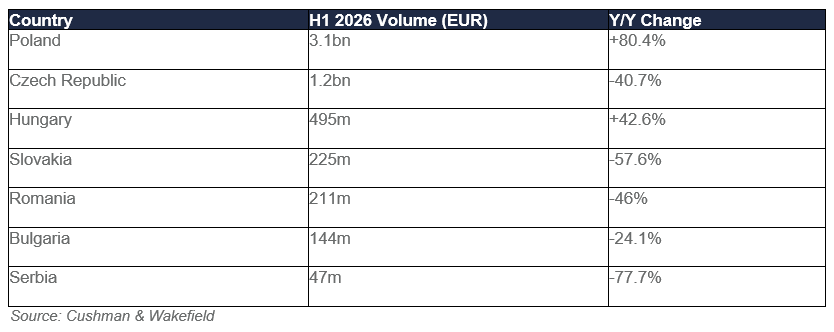
Poland recorded investment volume of EUR 3.1 billion in H1 2026, up 80.4% year on year and its strongest first half since 2018. Growth was supported by larger transactions, increasing portfolio activity and sustained investor demand across retail, logistics and selected office segments. The country’s average deal size rose from EUR 22.6 million a year earlier to approximately EUR 45.7 million, while portfolio transactions increased from 14% to 42% of Polish volume.
The Czech Republic recorded investment volume of EUR 1.2 billion, down 40.7% year on year. The decline reflects the absence of the large one-off portfolio transactions that characterised 2025, rather than any deterioration in underlying real estate market fundamentals. Hungary continued its recovery from 2025, with volume rising by 42.6% year on year to EUR 495 million. The market was supported by the country’s first major shopping centre sale since 2019.
Elsewhere, Slovakia (EUR 225 million, down 57.6%), Romania (EUR 211 million, down 46%), Bulgaria (EUR 144 million, down 24.1%) and Serbia (EUR 47 million, down 77.7%) all recorded year-on-year declines. These largely reflected limited product availability and high comparison bases rather than a broad-based slowdown in demand.
Marie Baláčová, Head of Head of Business Development Services, CEE+Nordics, Cushman & Wakefield: “The shift in the sources of capital is one of the most significant findings from the first half of the year. German capital’s share of regional volume rose from 1.6% to 11.4%, while the share of CEE-origin capital declined as outbound investment from the Czech Republic slowed. This represents a meaningful change in who is now setting the pace of pricing across the region.”
Several markets are positioned for a stronger second half than H1 volumes alone would suggest. This will, however, depend on the completion of transactions currently under negotiation. In Romania, a retail portfolio transaction and the sale of a logistics asset, with a combined value of approximately EUR 530 million, are expected to close by year-end. In Bulgaria, a cross-border retail transaction worth around EUR 122 million remains subject to regulatory approval. Poland’s pipeline of office, retail and long-income logistics transactions suggests that its current regional dominance is likely to continue through to the end of the year. Inflation and political uncertainty in Romania may continue to affect transaction timing, while improving investor confidence in Hungary is opening a window to capitalise on new opportunities early.
Table 1: CEE-7 investment volume by country, H1 2026