
Data centre construction costs across Australia and New Zealand are stabilising relative to other Asia Pacific markets, but the rapid adoption of artificial intelligence is fundamentally reshaping how facilities are designed, powered and delivered.
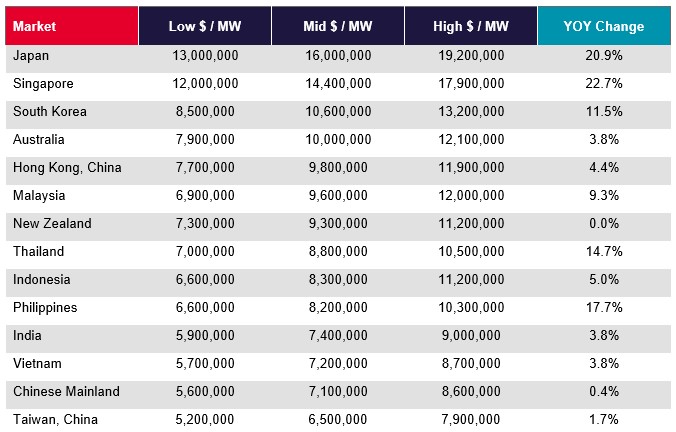
According to Cushman & Wakefield’s latest Asia Pacific Data Centre Construction Cost Guide 2026, Australia sits mid-pack in the region, with construction costs ranging from approximately US$7.9 million (AUD$11.01m) to US$12.1 million (AUD$16.8m) per megawatt (MW), while New Zealand ranges from US$7.3 million (AUD$10.2m) to US$11.2 million (AUD$15.6m) per MW.
While cost growth has moderated, with Australia recording a 3.8% year-on-year increase and New Zealand remaining stable, the report highlights that development complexity is rising as AI-driven requirements become the new baseline.
Andrew Green, Head of Data Centre Group, Asia Pacific at Cushman & Wakefield, said Australia and New Zealand are increasingly defined by their ability to deliver power-ready, scalable infrastructure.
“Across Asia Pacific, construction cost inflation diverges sharply, but in markets like Australia and New Zealand, the bigger shift is structural rather than cyclical.
“AI is reshaping the physical and technical requirements of data centres, particularly at the shell and core level. Higher power density, more complex cooling systems and stronger structural requirements are becoming standard, and that is changing how projects are costed and delivered locally.”
In established markets such as Sydney and Auckland, access to power and grid capacity is emerging as the key constraint on new supply, influencing site selection, delivery timelines and feasibility.
The report notes that competition for power-accessible sites, alongside longer grid connection timelines, is increasing delivery risk and placing greater emphasis on early-stage planning and procurement strategies.
“Power readiness is now one of the defining factors for data centre development,” Mr Green said.
“In Australia and New Zealand, projects that can secure reliable power early and align with evolving AI requirements are best positioned to move ahead, while others face extended timelines and rising delivery risk.”
Procurement dynamics are also contributing to cost variability across the region. Differences between supplier markets, longer equipment lead times and the increasing use of prefabricated and modular construction are all influencing project budgets and timelines.
At the same time, legacy facilities across ANZ are proving increasingly difficult to retrofit for high-density AI workloads, with many assets likely to be repositioned for alternative uses such as edge computing, interconnection hubs and lower-intensity storage.
Mr Green said “The findings reinforce a broader shift in development strategy, where feasibility is no longer driven purely by land and construction costs, but by access to power, supply chain resilience and the ability to deliver AI-ready infrastructure at scale”.
Regional Construction Cost Index
(ranked by mid-range cost and based on a mid-specification build)
To learn more, please download the report here

