
- Fifth Avenue reclaims title of world's most expensive retail destination
- Tourist flows, a growing affluent population, and limited new supply keep competition for prime international retail locations high
- In the Netherlands, occupier demand for the country's strongest retail pitches continues to outpace supply
Amsterdam, 20 November 2026 – Prime rents across 147 monitored retail locations worldwide rose 3% on average, though performance varied significantly by market. These are the findings of Main Streets Across the World 2026 by Cushman & Wakefield. Upper Fifth Avenue in New York is the world's most expensive retail street, with prime rents climbing 35% year-on-year to €25,000 per sq m per annum — reclaiming the top position for the first time since 2023.
In London and Milan, prime rents held firm following substantial gains in prior years. New Bond Street in London ranks second at €20,600 per sq m per annum, followed by Via Montenapoleone in Milan at €20,000 per sq m per annum.
The annual report tracks prime rents across 147 leading urban retail locations worldwide, focusing on the top segment of the retail market. Measured in local currency, rents rose an average of 3.0%, compared with 4.3% in 2025. That average, however, masks clear divergence between locations. Rents increased on 49% of locations, held stable on 32%, and declined on 19% of all locations surveyed. The Americas and Asia-Pacific recorded the strongest regional rent growth at 3.1%, followed by Europe at 2.7%. Asia-Pacific was the only region where rental growth accelerated, rising from 2.3% in 2025 to 3.1% in 2026.
The concentration of growing purchasing power also plays a role in the disparities in rent trends. In the United States, in particular, Cushman & Wakefield observes that affluent households are accounting for an increasingly large share of consumer spending. In areas where such high purchasing power converges with tourism, retailer demand for premium retail space intensifies, leading to greater competition for the best locations.
"While rental growth has moderated globally, competition for space in the world's most established retail destinations remains intense," said Robert Travers, Head of EMEA Retail. "Fifth Avenue's return to the top of the rankings demonstrates how quickly rents can rise when strong retailer demand meets limited supply. We are seeing similar dynamics in other major markets worldwide, where retailers continue to prioritise locations offering international visibility, strong consumer spending, and enduring brand value."
The Netherlands: stable prime rents, scarcity at prime locations
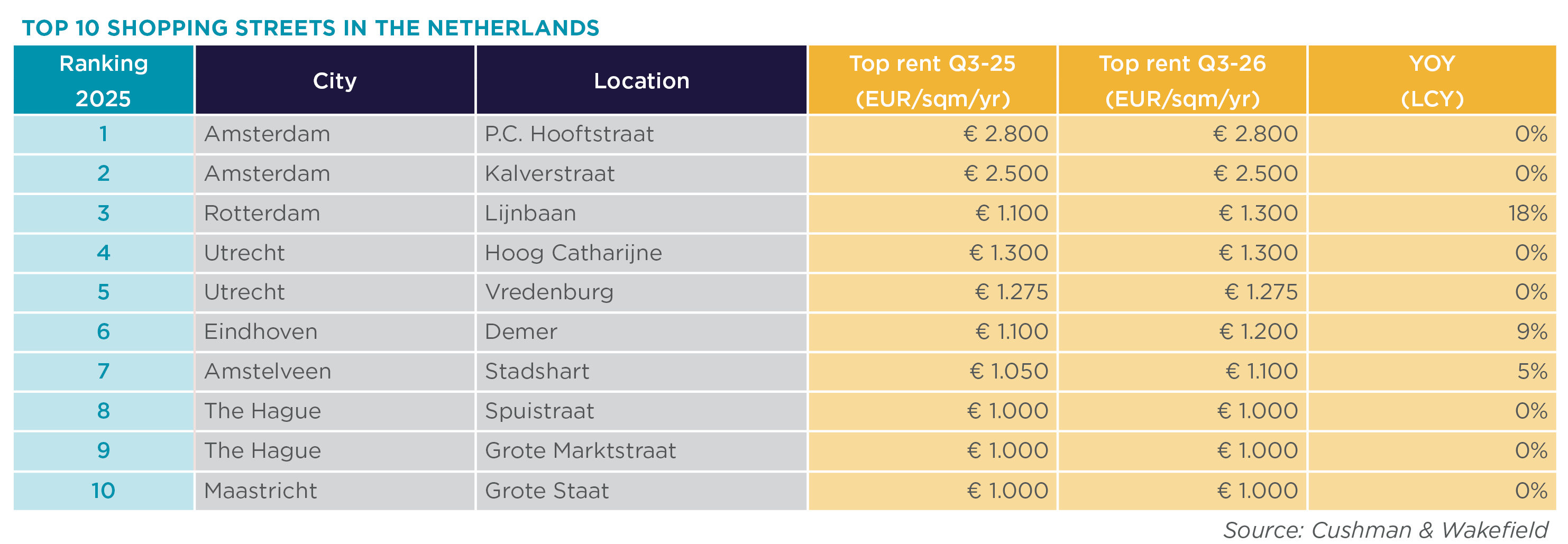
In the Netherlands, occupier demand for the country's best retail locations continues to outpace available supply. Prime rents on Amsterdam's P.C. Hooftstraat and Kalverstraat held steady at €2,800 and €2,500 per sq m per annum respectively, with P.C. Hooftstraat retaining its 20th place in the global rankings. Of the top ten Dutch locations, three recorded prime rent increases, seven held stable, and none saw a decline.
Increases were recorded on Rotterdam's Lijnbaan (+18%), the Demer in Eindhoven (+9%), and Stadshart Amstelveen (+5%). Stable prime rents in Amsterdam nonetheless mask the pressure on the limited available retail space at prime locations. In the 9 Straatjes, key money is once again being paid for small, well-suited units. Suitable space remains extremely limited in parts of the Leidsestraat and Van Baerlestraat as well. This is consistent with the international pattern identified in the report, in which competition for scarce retail space is re-emerging following a period of consolidation.
Michiel Boonen, Head of Retail at Cushman & Wakefield Netherlands: "Retailers continue to seek out the best pitch on any given retail street. Alongside strong visibility and high footfall, the surrounding retail mix — in terms of brand alignment and target audience — is an increasingly important factor in location decisions. As a result, demand within a single street can concentrate on just a handful of addresses. On the best locations in Amsterdam, suitable supply is extremely limited even as prime rents have remained stable over the past year. As with prime locations internationally, competition for the scarce available space remains intense."

View the 36th edition of Main Streets Across the World here.
