CONTACT US
Share: Share on Facebook Share on Twitter Share on LinkedIn I recommend visiting cushmanwakefield.com to read:%0A%0A {0} %0A%0A {1}

Office potential of the right bank of Warsaw

Marcin Miazek • 20/05/2022
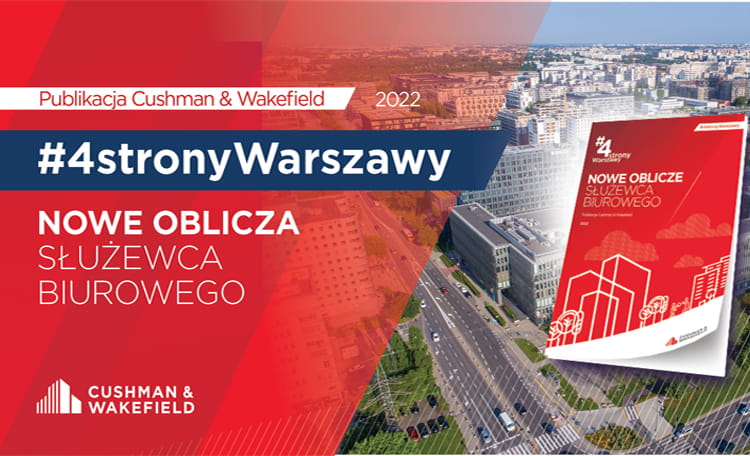
Global real estate services firm Cushman & Wakefield continues its series of mini reports focusing on interesting business locations on the map of Warsaw collectively titled “Four Corners of Warsaw”. The second instalment is about the right bank of the Polish capital.

Warsaw, a city with strong office development potential, epitomizes many directions of growth and the future of the property market. Its division into the left and right bank naturally gives rise to questions and speculation about the development of business space on each side of the Vistula River. Cushman & Wakefield’s report “Four Corners of Warsaw” investigates whether a large office hub is likely to emerge on the right bank of Warsaw and which locations have the greatest potential for office growth.

Close to 300,000 sq m of office space under construction on the right bank of Warsaw 

The eastern part of the capital contains 273,923 sq m of modern office space. It is a substantial amount but accounts for only 4.4% of Warsaw’s total stock. Most of the office space on the right bank of the city is located in Praga Południe (160,023 sq m, or 58%) and in Praga Północ (86,491 sq m, or 32%). The highest concentration of office space is in the square delineated by four roundabouts: Wiatraczna – Waszyngtona – Starzyńskiego – Żaba, where it stands at 165,100 sq m, which equates to 60% of the total stock on the right bank.

The first large offices on the right bank of Warsaw were built after 1996 in the Promenada shopping centre, Centrum Millenium and Galeria Wileńska. New office development was later driven by the construction of the second metro line, which significantly improved connectivity with other districts of Warsaw, boosting investor and developer interest in this location. Further improvements to transport infrastructure facilitated office development, with such projects coming on stream as Centrum Praskie Koneser, Praga 306, and Fabryka PZO.

The growth of Warsaw’s Praga is being significantly powered not only by the underground rail system; the National Stadium and the reorganization of its surroundings, the redevelopment of the right bank of the Vistula River and the regeneration measures taken as part of Warsaw’s Integrated Revitalisation Programme for 2015-2022 are increasing the attractiveness of the district and changing public perception, thereby improving the chances of success for other commercial projects. 

“The Praga side of Warsaw has great potential – its excellent location, proximity to the Vistula River, interesting old buildings and well-preserved historical urban fabric. Praga is well loved and connected to other districts by public transport. We have for years been committed to its revitalisation to support its vibrant economic, social and cultural life, but above all to improve the quality of living for local residents,” says Bartosz Rozbiewski, Deputy Director of the Department of Architecture and Planning, Warsaw City Hall

New office locations 

According to experts of Cushman & Wakefield, Warsaw is likely to continue to attract high levels of inward investment, largely thanks to its large job market with relatively low labour costs compared to Western European countries. 

Due to the shrinking land availability in the city centre, development activity is likely to spread to non-central zones such as Praga. As convenient transport connections are an important factor in office occupancy decisions, areas close to metro stations offer the largest potential for office development on the right bank of Warsaw. 

Locations with strong potential for new office development include Port Praski, Dworzec Wschodni, FSO Factory and Szwedzka. All these locations are easily accessible by public transport, making them attractive starting points for further projects. 

The added value, which office users expect buildings in this part of the city to provide, will also remain an important factor. As a result, we see the largest potential in further revitalisation projects and locations close to parks or the Vistula River. New office buildings are likely to be developed as part of larger mixed-use projects or to fill the gaps in the existing built fabric. However, large office hubs like Służewiec or Jerozolimskie Corridor are unlikely to emerge,” says Marcin Miazek, Associate, Office Agency, Cushman & Wakefield

Office development drivers 

Office development on the right bank of Warsaw is expected to be driven by further infrastructure improvements, particularly by enhanced transport connections with the city centre. This location will also benefit from the further extension of the underground rail system (the construction of the third metro line) and its integration with other means of public transport, as well as Dworzec Wschodni. Another important factor is the development of the road infrastructure, including the construction of the eastern section of the inner-city ring road and the completion of the eastern section of Warsaw’s ring road. Praga will also see its attractiveness grow with the arrival of the bike and pedestrian bridge, which will connect the right bank of the Vistula River and the Vistula Boulevards.
 

insights

rynek Starego Miasta 38, 00-401 Warszawa, Poland, Warszawa
MarketBeat

Poland MarketBeat

Cushman & Wakefield MarketBeat reports analyse quarterly Poland commercial property activity across office, retail and industrial real estate sectors including supply, demand and pricing trends at the market and submarket levels.
Ewa Derlatka-Chilewicz • 16/07/2026
Retail-Nederland
MarketBeat

Retail Marketbeat

Retail MarketBeat report analyses quarterly Poland commercial property activity across retail sector including supply, demand and pricing trends at the market and submarket levels.
Ewa Derlatka-Chilewicz • 16/07/2026
2352x720studenci.jpg
Research • Investment / Capital Markets

PBSA Market in Poland 2026

Rising expectations around comfort, location, and services are accelerating the development of private student housing, making it an increasingly attractive segment for institutional investors and a key factor in cities’ ability to attract talent.
Ewa Derlatka-Chilewicz • 24/06/2026
TR 2026 Grafika 2352x1040.jpg
Research

Trends Radar 2026 – Real Estate Market of Tomorrow: Trends Driven by Demographics, Innovation and Sustainability

Explore the trajectory of Poland’s real estate market – demographic shifts, technology adoption, ESG imperatives, and regulatory changes create both opportunities and risks.

Ewa Derlatka-Chilewicz • 01/12/2025
Generation 40
Insights

The 40 and 50 generations are changing the rules of the game in commerce

Demographic changes in Poland are gaining momentum, and the growing number of people aged 40+ and 50+ is redefining the consumer landscape.
Ewa Derlatka-Chilewicz • 20/10/2025
BEAS
Insights • Investment / Capital Markets

Warsaw Leads in Investment Attractiveness in Poland – BEAS 2025 Report Findings

The latest edition of the Business Environment Assessment Study (BEAS) 2025, jointly prepared by Antal and Cushman & Wakefield, presents for the fifth time a comprehensive evaluation of business conditions across Poland’s major metropolitan areas.
Ewa Derlatka-Chilewicz • 24/09/2025
Pharma Warsaw Card.png
Research

Zoom in on the pharma sector

Warsaw’s office market plays a vital role in the development of the pharmaceutical sector in Poland. Nearly half of all pharmaceutical companies in the country are based in the capital, drawn by a dynamic business environment, modern infrastructure, and access to a highly skilled talent pool.
Ewa Derlatka-Chilewicz • 11/06/2025
warehouse, report, industrial, cushman, e-ccomerce
Research • E-Commerce

Quo Vadis E-commerce 2024

We’re excited to present our latest report, “Quo Vadis E-commerce 2024”, which explores the evolving trends and dynamics of the e-commerce market.
14/11/2024
GWS-Poland-Insights-housing sector report large Hero.jpg
Research

The housing sector at the crossroads 2.0

The average flat size in Poland is 21 sq m smaller than the EU average and the overcrowding rate is nearly 20 percentage points higher, says global real estate services firm Cushman & Wakefield in its latest report The Housing Sector At The Crossroads 2.0. 

Karolina Furmańska • 26/07/2024
obsolescence-emea-webcard
Insights • Workplace

European Obsolescence Equals Opportunity

Repositioning: The Evolution of European Offices 
Sukhdeep Dhillon • 14/03/2023

CAN'T FIND WHAT YOU'RE LOOKING FOR?

Get in touch with one of our professionals.
With your permission we and our partners would like to use cookies in order to access and record information and process personal data, such as unique identifiers and standard information sent by a device to ensure our website performs as expected, to develop and improve our products, and for advertising and insight purposes.

Alternatively click on More Options and select your preferences before providing or refusing consent. Some processing of your personal data may not require your consent, but you have a right to object to such processing.

You can change your preferences at any time by returning to this site or clicking on Cookies.

MORE OPTIONS
Agree and Close
These cookies ensure that our website performs as expected,for example website traffic load is balanced across our servers to prevent our website from crashing during particularly high usage.
These cookies allow our website to remember choices you make (such as your user name, language or the region you are in) and provide enhanced features. These cookies do not gather any information about you that could be used for advertising or remember where you have been on the internet.
These cookies allow us to work with our marketing partners to understand which ads or links you have clicked on before arriving on our website or to help us make our advertising more relevant to you.
Agree All
Reject All
SAVE SETTINGS