
NEW YORK – Cushman & Wakefield, a global real estate services firm, released a new research report highlighting a growing divide in Downtown Manhattan’s office market, where demand for top-tier, amenitized buildings is driving an increasingly pronounced gap in both performance and pricing across asset classes.
According to the report, since 2020, 73% of the downtown leasing activity was concentrated among Class A buildings, with Class B and lower-tier assets experiencing declining demand, longer marketing periods and reduced tour activity, underscoring a clear and sustained flight-to-quality trend. This is fueled by tenants that are seeking modern office environments with hospitality-driven amenities and thoughtfully curated retail offerings.
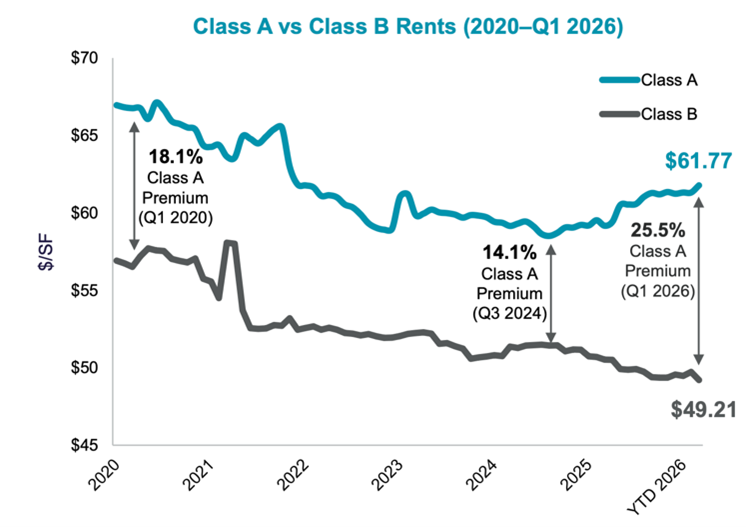
For Class A space downtown, the rent premium over Class B space was 25.5% as of Q1 2026 – this marks a more than 11% increase in the asking rent gap between the asset classes since mid-2024. This comes on the heels of a strong Q1 for the downtown market, which recorded 2.9 million square feet (msf) of leasing activity, the second-highest quarterly total on record, and a $0.44 per square foot (psf) increase in rents, which averaged $56.67 for all asset classes in Q1. Class A rents rose by $0.54 psf to $61.77.
“Downtown’s office market is continuing to evolve into a distinctly bifurcated landscape, where the highest-quality assets are capturing the overwhelming share of demand and pricing power,” said Maddie Askeland, Data Specialist at Cushman & Wakefield. “What’s notable is that this divide is no longer just about the building quality or the amenity offerings, it is increasingly evident in the rent gap, which we expect will continue to widen as the year progresses.”
Jared Lewis, Senior Research Analyst at Cushman & Wakefield, added “As tenants prioritize quality, experience and long-term workplace strategy, the divergence between top-tier and lower-tier assets is expected to accelerate. Without significant reinvestment, repositioning, or conversion, older buildings will likely face continued downward pressure on rents, further reinforcing long-term value disparities across Downtown Manhattan’s office market.”
