CONTACT US
Share: Share on Facebook Share on Twitter Share on LinkedIn I recommend visiting cushmanwakefield.com to read:%0A%0A {0} %0A%0A {1}

ODCE Fund Allocations To Multifamily On The Rise

Sam Tenenbaum • 9/12/2022

Noteworthy highlights:  

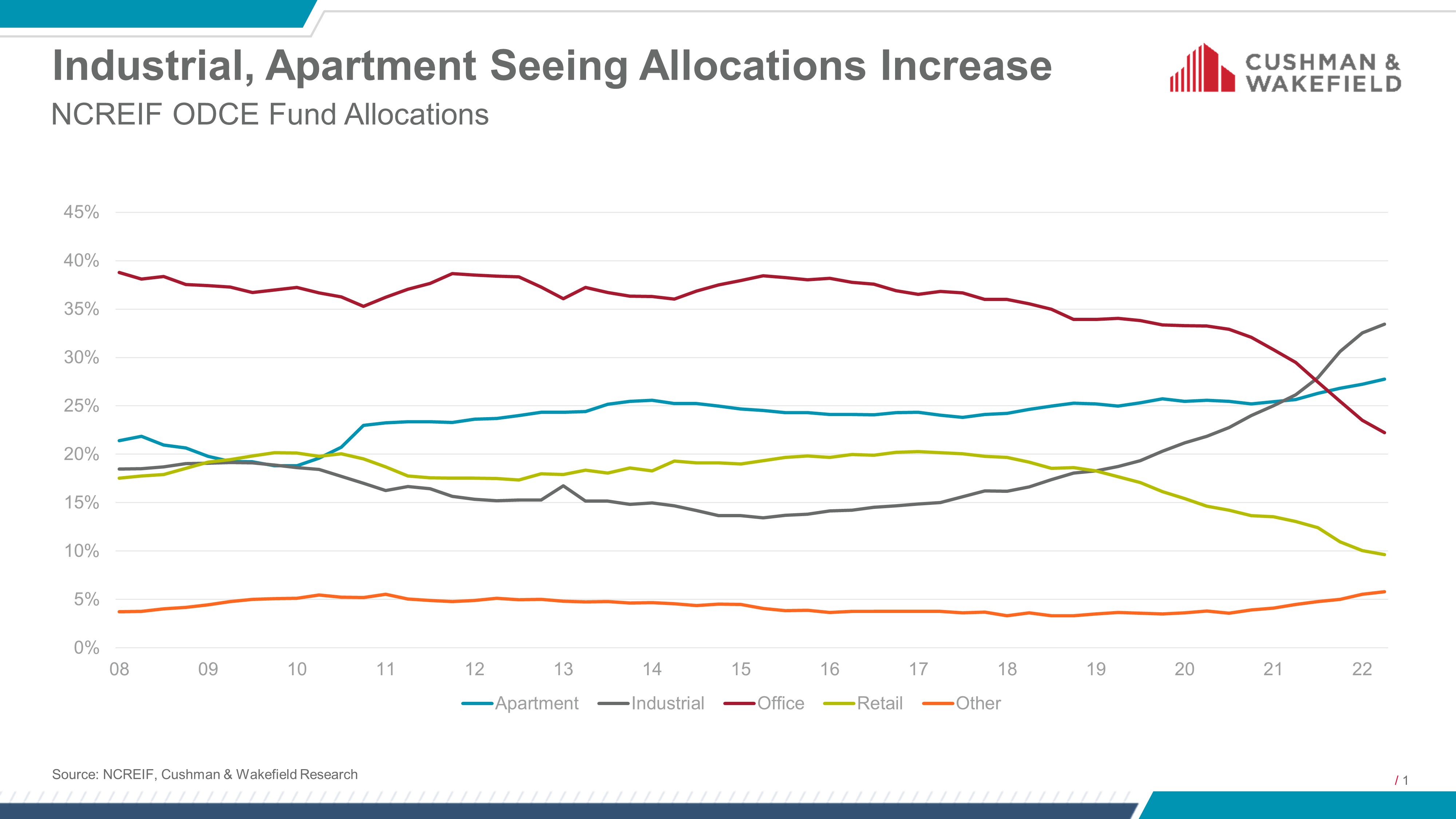
  • Office: Allocation to office real estate is declining quickly. With the prospect of remote work and a potential looming recession or economic slowdown, the macro outlook for the office sector remains cloudy. There will be some bright spots, but the uncertainty has core investors putting their dollars into other asset classes.  
  • Retail: Despite posting the best risk-adjusted returns over more than 40 years, retail has been on a long-run secular decline, ceding ground to industrial. The sector is also bifurcated; malls and power centers are more exposed to the rising threat of e-commerce compared to neighborhood and strip centers, which continue to perform well.  
  • Industrial: Industrial’s performance has caught the attention of institutional investors, overtaking all other asset classes to be the dominant property type in ODCE funds. Today, industrial represents nearly 35% of all ODCE fund allocations, up significantly from 2015 levels, where it was less than 15%.  
  • Apartment: Multifamily remains a steady component of ODCE funds, but as allocations to office and retail fall, core investors are placing more of that capital into multifamily. For much of the past decade, multifamily made up about 25% of ODCE portfolios, but that is quickly approaching 30%, a mark it will likely reach around the end of the year or early next year. 

Why do these trends matter? 

  • As institutional investors place capital, they are increasingly devoting investment dollars to asset classes with strong tailwinds: multifamily and industrial.  
  • While capital continues to chase industrial, the story is more nuanced and asset-specific than multifamily. There can be major NOI pops with shorter-term leases, especially in high-growth markets, but that’s not the case for every asset.  
  • With industrial more exposed to the real economy and a slowdown in demand for goods, we may see allocations to multifamily increase in the months to come.  
    • This is already occurring: multifamily has represented more than 45% of all sales volume year-to-date. 
 

ODCE-Allocations

author / contact


sam tenenbaum
Sam Tenenbaum is Cushman & Wakefield’s Head of Multifamily Insights. In this series, he shares unique perspectives on today’s multifamily market, gathered from Cushman & Wakefield’s unique data on the lending environment, strong capital markets presence and the 175,000 units that we manage across the U.S. 

Multifamily Capabilities
Our Multifamily advisors help supercharge your portfolio, beyond the typical “where, why, and how” of investing in and managing multi-unit properties.
Learn more

Related Insights

Richmond Virginia skyline
MarketBeat

Richmond

Cushman & Wakefield MarketBeat reports analyze quarterly economic and commercial real estate activity including supply, demand and pricing trends at the market and submarket levels.
Liz Greving • 4/9/2026
unlocking-value-webcard-trains
Research

​Unlocking Value From Transport Infrastructure​

Explore how train station adjacent redevelopment can unlock long‑term economic, social and environmental value through placemaking, market insight and strategic partnerships.
Dominic Brown • 4/9/2026
Houston Skyline
MarketBeat

Houston

Cushman & Wakefield MarketBeat reports analyze quarterly economic and commercial real estate activity including supply, demand and pricing trends at the market and submarket levels.
Sherra Gilbert • 4/9/2026
Chicago Downtown Skyline Along River
MarketBeat

Chicago

Cushman & Wakefield MarketBeat reports analyze quarterly economic and commercial real estate activity including supply, demand and pricing trends at the market and submarket levels.
Gregory Rogalla • 4/9/2026
tariffs-cre-construction web card
Article • Construction

The Impact of Tariffs on U.S. CRE Construction Costs

​​Tariffs introduced over the past year are estimated to raise U.S. CRE construction material costs by 6% and total project costs by 3% relative to the pre-tariff era. With labor and energy also top-of-mind, construction faces ongoing headwinds in 2026. ​
James Bohnaker • 4/8/2026
Navigating-Tariffs-web-card
Article • Government / Public Sector

Navigating Tariffs in Real Estate Development: Protecting Projects and Investments

Tariffs on construction materials can create serious challenges for tenants, developers and investors alike. Rising costs, extended lead times, and regulatory uncertainty can quickly derail even the most carefully planned projects.
Andy Jansen • 4/8/2026
Memphis Skyline Aerial
MarketBeat

Memphis

Cushman & Wakefield MarketBeat reports analyze quarterly economic and commercial real estate activity including supply, demand and pricing trends at the market and submarket levels.
Tim Rollins • 4/8/2026
penn-station-webcard.jpg
Research

Next Stop: Penn Station

Examine office tenant relocations across Manhattan from 2023 to 2025, highlighting the Penn Station submarket as the leading destination for inbound square footage.
Jake Williams • 4/7/2026
Cross‑Border Capital and CRE
Article • Investment / Capital Markets

Cross‑Border Capital and CRE: Early 2026 Signals Across Regions and Strategies

Global commercial real estate (CRE) capital markets are operating under elevated geopolitical and policy uncertainty, with the Iran conflict contributing to renewed volatility across financial markets.
Sam Tenenbaum • 4/6/2026
reasons-for-move-out-web-card-v2
Article

Sky-High Mortgage Rates Benefitting Multifamily

With mortgage rates approaching 7%, we wanted to see the material impact of the movement in the market. Using data from Cushman & Wakefield Asset Services, which looks at the self-identified reasons that renters are moving out, we’ve laid out the share of renters that have said they were moving out of our managed communities to buy a home, condo, or townhouse.
Sam Tenenbaum • 9/28/2022
odce-fund-allocation-web-card-v2
Article

ODCE Fund Allocations To Multifamily On The Rise

Here, we look at data on the flow of core institutional capital across asset classes. The data comes from NCREIF’s ODCE index.
Sam Tenenbaum • 9/12/2022
btr-starts-web-card-v2
Article

Housing Starts Down But Single Family for Rent and Built-to-Rent Remain Strong

The Census recently released second quarter starts data, and as expected, we continue to see a pullback in the single-family market. Overall housing starts continue to decline with single-family starts back to 2019 levels.
Sam Tenenbaum • 8/22/2022

Interested in learning more?

Get in touch and we can assist with any additional information you need.

With your permission we and our partners would like to use cookies in order to access and record information and process personal data, such as unique identifiers and standard information sent by a device to ensure our website performs as expected, to develop and improve our products, and for advertising and insight purposes.

Alternatively click on More Options and select your preferences before providing or refusing consent. Some processing of your personal data may not require your consent, but you have a right to object to such processing.

You can change your preferences at any time by returning to this site or clicking on  Cookies

More Options
Agree and Close
These cookies ensure that our website performs as expected,for example website traffic load is balanced across our servers to prevent our website from crashing during particularly high usage.
These cookies allow our website to remember choices you make (such as your user name, language or the region you are in) and provide enhanced features. These cookies do not gather any information about you that could be used for advertising or remember where you have been on the internet.
These cookies allow us to work with our marketing partners to understand which ads or links you have clicked on before arriving on our website or to help us make our advertising more relevant to you.
Agree All
Reject All
SAVE SETTINGS